
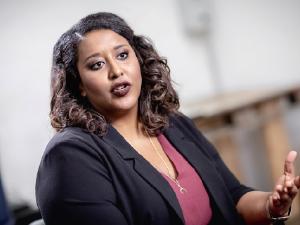
What did the three letters dpa mean to you before you knew you were moving to Germany's biggest news agency?
I've always associated dpa with quality and being up-to-date. dpa is important, dpa is a full-service provider, there’s simply no getting around dpa. The agency is a media institution. But I didn't know before that there were more than 150 products in total. And I didn't know that dpa was doing so well when it came to innovation projects.
At dpa you will be responsible for product and innovation. What makes this area particularly attractive for you?
I find it exciting developing products for the entire media landscape. With a product understanding that doesn't just refer to the content, but sees the content plus the carrier and distribution as a whole. What's more, I was excited by this role, in which the editorial and the product are really integrated, where I’m able to really get things going – from the idea to the concept and implementation. It is also thrilling for me to have an impact on the entire media landscape.
In your opinion, what makes a good journalist?
Curiosity. And not only curiosity about new stories and new narrative styles, but also curiosity about what's happening around us right now. Especially when it comes to the upheaval in the media market. Everyone doesn’t have to be able to do everything. But everyone should understand everything that is happening. We need more good journalists who are also interested in the financing of good journalism. Or who at least have an understanding that a good story alone is not enough to be successful.
You're a 34-year-old woman, who was born in Khartoum. That's unusual for the top management at dpa, but also for the German media as a whole. To what extent do you see yourself as a role model for social change?
My path, my career and my topics would not have existed five to 10 years ago. Today I'm perhaps a role model that shows that someone can arrive at a large media company without any alliances or connections, and still get a chance to prove themselves. Just like I got a chance at Axel Springer. For me, the message is that, as a migrant or as someone with a visible or invisible migration background, you are allowed to choose what you are interested in and what you want to do just as much as an ethnic German can. People with a migration background also have opportunities. This can also apply to a topic such as digitalization, which has nothing to do with their background. If I can be a role model for taking your life in your own hands, and fighting for your own topics and also opening up yourself to them, then I’ll very happily do so.
You have been included in Medium magazine’s Top 30 under 30 and also kress’ Top 25 young executives. What has that done for you, and what do these awards mean to you?
II am delighted about the appreciation and recognition for my work. At the same time, recognition in everyday life and on a small scale means much more to me. The appreciation of colleagues, the appreciation of my bosses, the good cooperation also in teams – that is the greatest award for me.
Why is data so important? Why do we need to know so much about our readers?
I once read a nice sentence by a computer scientist: Without data you are just another person with an opinion. I believe that data-informed work is the key to success. Data-driven, as it is often called, is in my view a somewhat misleading term in the classic editorial context. This term assumes that there is an automatism that makes the decisions. I believe in the following combination: Give your editorial staff all the relevant information that is available and train the right people to prepare and analyze this data and formulate recommendations for action from it. Then they will make the right deductions from it. But don't let the machine make the journalistic decisions for you.
Why do we still need print today?
I believe that we will soon be bidding farewell to some well-known daily newspapers. And that print and the look and feel of a real newspaper must be strongly connected with the respective attitude to life. For example, a Sunday lifestyle feeling. I treat myself to my Sunday newspaper, for example. Readers notice that the daily national newspaper can no longer show what is happening in the world in real time. You're always lagging behind, and as a result the digital offerings become more attractive. But that's not all bad news, it forces us to work in an even more user-centered way: What needs do readers really have? What do they want to receive, when and how, on which analogue or digital platform? What habits do they have? And how can we cultivate new habits and produce new formats based on them? This, for example, is what the extremely important area of user research is all about.
You are responsible for innovation at dpa. What do you think determines whether an idea is turned into a real innovation?
In order to go from the idea to the innovation, you need execution. An idea alone or a collection of ideas is not an innovation. For me, innovation and innovation management are strongly linked to problem solving. This is not meant to be generic, but has to do specifically with your own context, your own brand and your business. Everyone who deals with innovation professionally has to deal intensively with the problems their own company actually has – and which levers there are to solve them. Ideally, innovation is a creative solution to precisely these problems. For me, however, innovations are not flagship projects. By this I mean thinking up something once a year on an Innovation Day, but then having no process, no culture and no approach towards what innovations actually are and should achieve day-to-day. In order not to fall into the trap of innovation simulation, one should say goodbye to glitter pony projects. That is one-shots, that are only used once and consume an incredible amount of resources. I'm known for asking: why. If there's no answer, not even a hypothesis, then something went wrong in the process. Then probably somebody said we had to do something innovative again. That's not satisfactory approach. Innovations have to solve problems.
Is this also your understanding of innovation management?
In the contexts in which we operate as a media brand, we are not always able to solve big problems on our own. You need management because different departments are involved. There is a product department that has a say, the business development department, the new business department, the editorial offices, the data analysis department. Many very different and very important sections want to be taken along, included and involved. If you just push in and blindly try to inform people and win them over for a project, you burn through resources. You have ensure you have channel processes and stakeholder management: who talks to whom, when, why and with what goal? You have to tie that down bindingly, otherwise people will get lost and spend months in undefined processes. That wastes precious time that you need for the big issues and challenges. Planning and control can be decisive for success.
How visible should journalists be on social media?
As a journalist who is always on the lookout for new stories, for impulses, for inspiration, for things that fascinate, I believe it would be a waste to completely block out this world. To say from the beginning: "I have my sources. I have my stories. I'm not interested in what's happening in the world." That's the real message behind it. But it also doesn't hurt to reflect critically on one's own social media behavior in order not to fall into the trap of constantly wanting to constantly register one's own opinion, one's own theses, one's own contributions. This also draws time and energy away from other topics. I am currently pleading for a conscious approach to social media. In other words, to think carefully: why am I doing this now? Does this content have to be posted by me? What added value does it have for third parties? You need to stop and reflect. That means: it’s fine participating in social media, but you don't have to and shouldn't broadcast non-stop.
Is this a new insight or has it been your strategy for some time?
I've lived in feeds and comment sections for years. Also, professionally. I have probably looked at and answered over a million reader comments in my life. For me, social media was very important. But I never documented my whole life there. Focusing is important to me. For example, I think it's great when people publish Instagram stories. I did that for a while. But I wasn’t really able to answer the question of what I actually got out of it, and I still can't really answer that today. I've been using social media in a reduced form for about a year and a half – and haven't regretted it yet.
Let’s talk about AI or artificial intelligence. A blessing or curse for journalism?
I believe that artificial intelligence can relieve us of many of the tasks that journalists originally did not do at all. It's all about redundant, administrative, repetitive tasks that don't have to be done by a journalist. I believe that AI is primarily used as an assistant and doesn’t replace journalists. Here’s a concrete example: How time-consuming are transcriptions? Nobody became a journalist to transcribe an interview for three hours. But we know that this is necessary to get the story out. When testing an AI transcription tool, there was a real "aha" moment in the editorial office of my previous employer. The tool solves a problem that (almost) every reporter has. But in the end, someone has to go through the AI transcript again, because it doesn't produce broadcast-capable transcripts. Quality control is indispensable, and it is the journalist who does that. So, it's not about replacing journalists with AI, but about taking on the unpleasant tasks that really have nothing to do with journalism.
Suppose you meet a teenager who has been socialized with Snapchat, Instagram, YouTube. Occasionally he might have read a newspaper or seen the news. So, all in all far removed from what we call classical media. How would you explain to him that what we do is still important?
I would probably choose a big, memorable event. For my generation this is 9/11, I experienced the event myself as a teenager and remember exactly where I was, what I was wearing, who I was with when it happened. I would try to build a bridge for this teenager to a comparable event. Imagine you couldn't have seen it on TV. Imagine you couldn't have read about it in the newspaper or on the Internet, but you had to rely on one of your friends to tell you through his or her eyes. Imagine what your life would be like if you only knew everything from hearsay. In this way I would try to make it clear to him or her what a loss that would be.
How important is laughter and humor in your job?
Very important. My experience is that employees – and I include myself in this – who feel comfortable, do a better job, enjoy coming to work, have better ideas, are creative and motivated. It's a people business. Of course it's still not a silly comedy club that we go to every day. But it's important to know: I am here in a place where I am valued as a person and as an employee in my entirety. You don't have to pretend or completely hide certain sides of yourself. If you feel accepted and you feel comfortable, then you also deliver better results.
What makes you angry in your job?
I get angry when people complain and demand a lot, but are not solution-oriented and do not deliver. I’ve also little understanding for people who are not empathic, i.e. have no antennae for what is happening around them. For me, focusing is also a big topic. Often the topics of empathy and focus are connected: Someone finds things urgent that are not urgent at all. Someone sends miles of e-mails every five minutes, from which you then have to pick out the relevant passages.
What makes me happy: constructive and motivated people who think, can focus, want to shape and think in terms of potentials and solutions rather than problems.
How do you lead your teams?
I used to think that I would have to think of a boss role that works independently of my personality. Today I am very good at simply being Niddal, who is in a management position, and not the boss who is only human again after 6.30 pm. I believe in empathic leadership, which is not to be equated with a cozy relationship. I would describe myself as hard, but cordial and fair and demanding in leadership. I'm also don’t mind saying: "We don't know that right now," or "Think of something." I believe that you don't have to carry everyone across the finish line, but that you should empower employees to take responsibility for themselves.
What motivates you?
What drives me professionally is that I want to secure the future of journalism and make my contribution to it, also because I know how important this is. I come from Sudan, a country where journalists have been harassed by the government for decades. Personally, that drives me to create a noticeable impact in a socially relevant area with what I do. I am also motivated by my parents, my husband and my brother. They have always supported me. I haven’t come in on anyone else’s coattails. I didn't know anyone as a teenager who worked in journalism. With the support of wonderful teams, bosses and my own hard work, I was able to make my own way and thus show people that you can achieve something in the media industry even without connections.
What did your parents teach you?
Not to let myself be distracted, not to listen too much to what others say, not to allow myself to be discouraged, to follow my own path, to work hard and sometimes to say no. I am not known to just go with the flow and see what happens, but to stand up for myself. They taught me not to be pushed around and to always fight.
How do you like to spend your time when you’re not at work?
I like singing very much. I spend a lot of time with my friends, almost all of whom are in Berlin, and with my husband. And gladly without a mobile phone.
Final question: Where do we find the key to a long-term successful journalism? In technology, in young people or in the best stories?
I can answer that very quickly. In the content. Brand, content, container and user experience. I see technology as a lubricant that helps us to discover, produce and distribute the best content.
 The complete new dpa editorial board: Antje Homburger (deputy editor-in-chief and head of news production), Jutta Steinhoff (deputy editor-in-chief and head of network), Niddal Salah-Eldin (deputy editor-in-chief and head of innovation and product), Sven Gösmann (editor-in-chief).
The interview was conducted by Jens Petersen, Head of Corporate Communications at dpa.